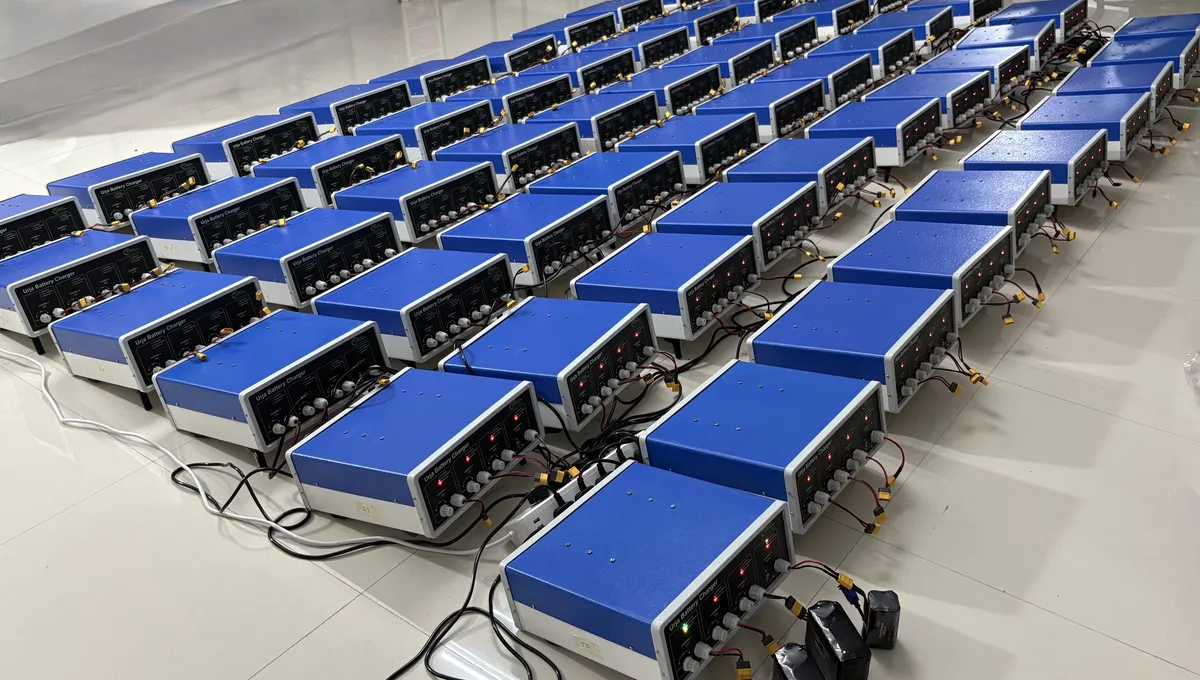
Charging Infrastructure for Drone Logistics: The Part of the Network Nobody Designs First
Every drone delivery business plan starts with aircraft, routes, and payloads. Almost none start with the charging depot. Yet when the network goes live, it is the depot that decides how many aircraft you actually need: a fleet that charges slowly is a fleet you must buy twice. We wrote about the battery side of this in logistics drone batteries — this post covers the ground half of the equation.
1. Charge fast, but charge smart
Fast charging is the obvious requirement — our packs reach a full charge in as little as 30 minutes. But speed without intelligence shortens pack life, and in a logistics fleet, battery replacement is one of your largest recurring costs. A smart charger negotiates with the pack's BMS, adapts the charge profile to the pack's temperature and health, and logs every session. You get the speed without quietly burning your battery budget.
2. Decide your model: charge on the aircraft, or swap
There are two workable depot models. Charging on the aircraft is simpler — fewer packs, less handling — but the aircraft is grounded while it charges. Battery swap keeps aircraft flying almost continuously, at the cost of a larger battery pool and packs engineered for hundreds of swap cycles. The right answer depends on your route density and delivery windows, and the battery must be designed for the model you choose: swap latching and blind-mate connectors are pack-level features, not depot accessories.
3. Schedule charging like you schedule deliveries
A depot with ten chargers all starting at once is a depot with a power problem. Because our chargers and packs both report telemetry, charging can be scheduled the way flights are: staggered against your delivery windows, prioritized by which packs are needed next, and balanced against the site's electrical capacity. The charging rack stops being a black box and becomes part of your operations dashboard.
4. Plan for weather and the field
Not every depot is an air-conditioned warehouse. Our packs are rated for cold-weather operation down to −20°C, and charging in the cold is exactly when smart charge management matters most — charging a cold lithium pack incorrectly is one of the fastest ways to destroy it. Chargers built for field deployment handle pre-heat conditions and refuse unsafe sessions on their own.
One partner for the whole power chain
The battery, the BMS, and the charger behave as one system — so they should be engineered as one. That is the case we make in our complete power solution: matched charge profiles, one telemetry stack, and one partner accountable for the whole chain. At Revogreen Technologies, we supply drone batteries, smart chargers, and power management together — engineered and made in India, with over 30,000 batteries delivered.
If you are planning or scaling a drone delivery network, let's design the depot before it designs your fleet size.
Looking for Custom Battery Solutions?
Revogreen Technologies designs application-specific battery systems for UAVs, defence, and industrial applications.
Get in Touch